
Thank you, as always, for reading this blog.
The Megasphere Match is currently underway.
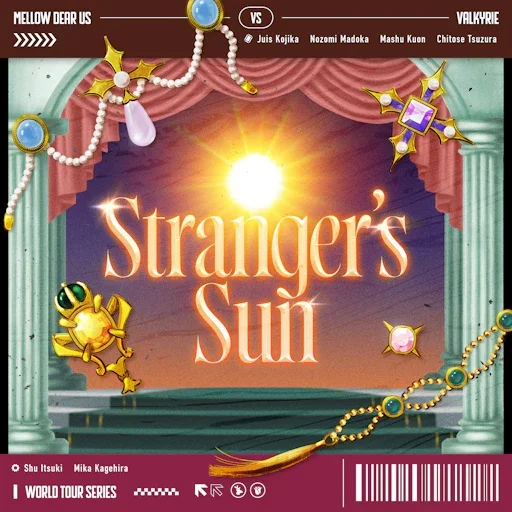
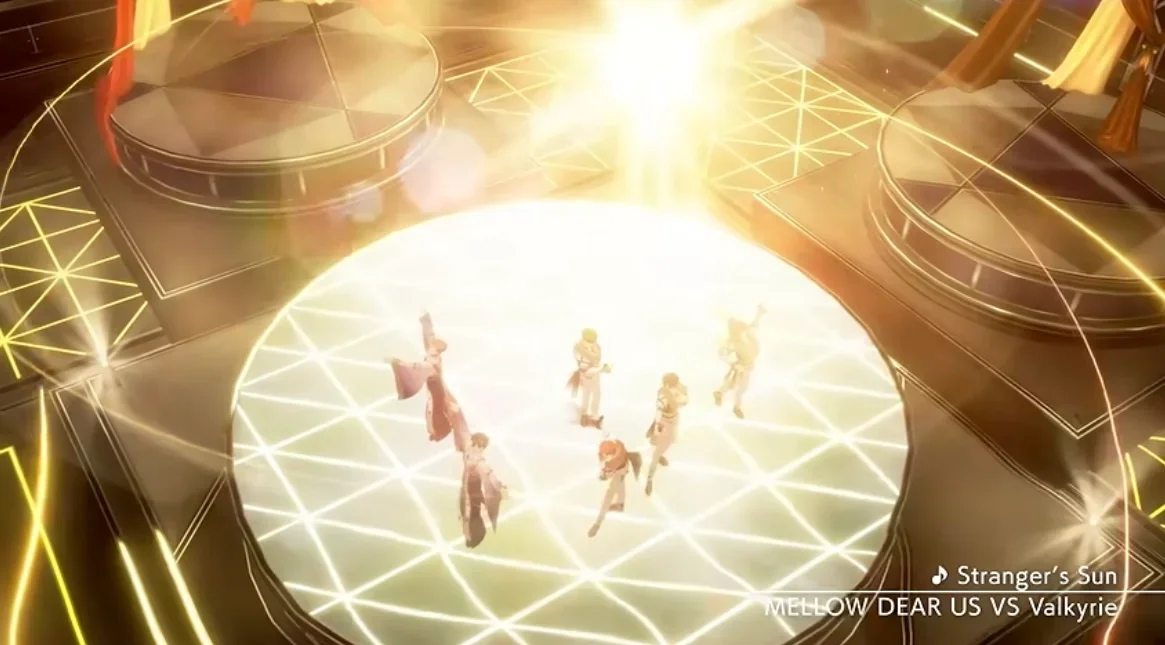
At last, the full picture of "Stranger's Sun" — the joint song where two utterly opposed units, Valkyrie and MELLOW DEAR US (MDU), intersect — has revealed itself before us.
At last, the full picture of "Stranger's Sun" — the joint song where two utterly opposed units, Valkyrie and MELLOW DEAR US (MDU), intersect — has revealed itself before us.
Before we enter the main discussion, please allow me a small personal confession.
In truth, when I first built my analysis from the fragmentary information available about this song, a faint "haze" hung over my heart.
That was because, without intending to, I had become trapped in a simplistic contrast: as if Valkyrie were the "good that resists" the system, and MDU the "evil that is dyed by it."
That was because, without intending to, I had become trapped in a simplistic contrast: as if Valkyrie were the "good that resists" the system, and MDU the "evil that is dyed by it."
But now that all of the lyrics and the MV have been released, what has come into view is nothing so trite as a framework of good and evil.
Both sides carry a passion that makes them impossible to rank, and, brandishing the "justice" and "aesthetics" each believes in head-on, they stood upon the same stage.
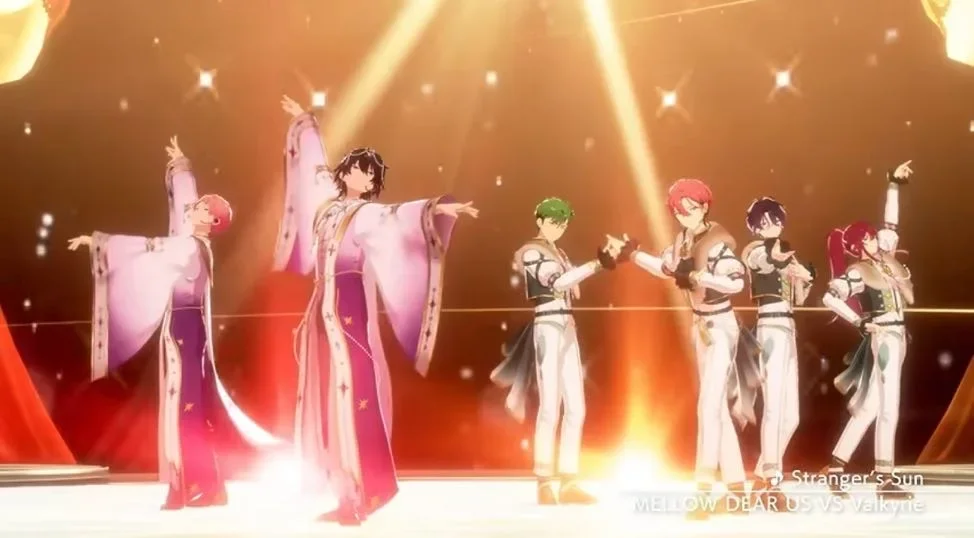
And, as if looking down upon that fierce clash of souls, a giant "sun" blazes above their heads.
"Stranger's Sun" —.
Who is the "Stranger"? And what, in truth, is this sun that seeks to burn them away?
Untangling the motifs of The Stranger, the masterpiece by the French author Albert Camus, I would like to think deeply about the truth of "one sun," which shines equally upon "Eternity (Valkyrie)" and "the Moment (MDU)."
ATTENTION ※This article contains discussion of characters' pasts (grievous traumas and views on life and death) and personal interpretations of literary works. If dark themes make you uncomfortable, please turn back here.
Question and Answer — This Song Is Complete in Its First Four Lines
How many souls, in all, were born and vanished, leaving no name behindOnly fervor lit the fire; cheers are life itselfEverybody wants a dream.
First, please look at the opening of the song. It is no exaggeration to say that everything in this piece is already spoken here.
Mika asks. How many souls, in all—, he asks.
Shu takes it up. Born and vanished?
And the two of Valkyrie declare in unison.
Leaving no name behind.
Shu takes it up. Born and vanished?
And the two of Valkyrie declare in unison.
Leaving no name behind.
Countless souls, born and gone without leaving a name.
For the nameless artists buried in history, this is a requiem — and at the same time, I believe, a primal fear of oblivion and consumption.
For the nameless artists buried in history, this is a requiem — and at the same time, I believe, a primal fear of oblivion and consumption.
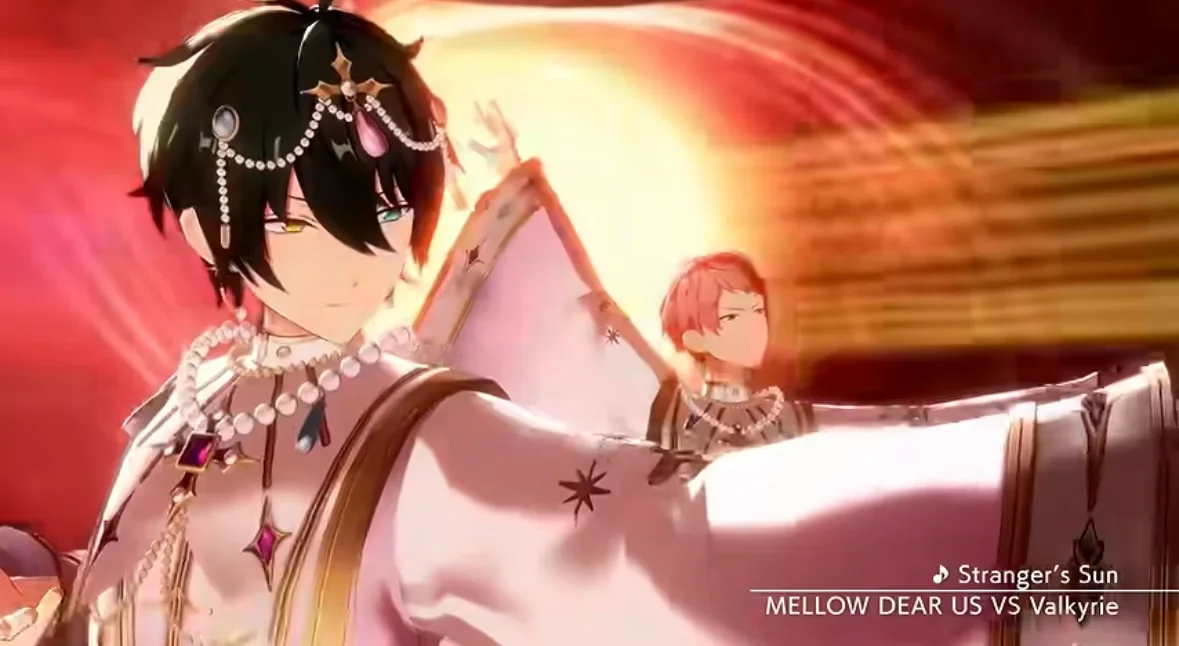
To that question, Mashu answers.
Only fervor lit the fire.
Only fervor lit the fire.
Juis continues, asserting: Cheers are life itself.
……Have you noticed? To Valkyrie's question, MDU is answering.
Moreover, this exchange makes the contrast between the two unmistakable.
To Valkyrie's question, MDU replies, "It isn't logic — the heat of this moment proves everything," and, rather than thinking with their heads about "how to leave something for posterity," they answer that the facts right before their eyes — "fervor" and "cheers" — are themselves the proof of life.
Within four lines of meeting, the two souls have already split head-on.
……It is a stinging exchange from the very opening, but toward the song's climax, this collision of "the Moment" and "Eternity" will be repeated once more — this time as a bared blade.
……It is a stinging exchange from the very opening, but toward the song's climax, this collision of "the Moment" and "Eternity" will be repeated once more — this time as a bared blade.
The Sun of The Stranger: A Light That Hates No One and Protects No One
Here, in order to untangle "Stranger's Sun," let me speak for a moment about another essential element: what kind of presence the "sun" was in Camus's The Stranger.
**(※Because this work is a world-renowned masterpiece, a great many interpretations exist. What follows is not presented as the single correct answer, but extracted as "one facet" that serves as the axis of this song analysis.)The protagonist, Meursault, is a young man who did not shed a single tear at his mother's funeral.
However, he did not refrain from crying in order to rebel against society. He simply never had the very idea of performing feelings he did not have.
He did not refuse to lie; he was unable to lie.And so he showed not a single tear at his mother's funeral, and none of the attitude of "grief" that the world demanded.Later, on a beach beneath a sun blazing down relentlessly, he becomes caught up in a sudden quarrel and impulsively shoots an Arab man dead.Asked at his trial for his motive for the murder, he answered only: "Because the sun was dazzling."But what the court condemned most was not the murder itself, but the "cold-heartedness of not shedding tears at his mother's funeral."In the end, he is sentenced to death as a monster who breaks the rules (— a stranger).
What matters here is that, in the original work, the "sun" that drove Meursault mad takes no one's side.
The sun does not hate him. It does not punish him.
It merely pours down an equal, overwhelming heat.
And yet, that indifferent heat is precisely what scorched away human thought and, in the end, led one young man to ruin.
It merely pours down an equal, overwhelming heat.
And yet, that indifferent heat is precisely what scorched away human thought and, in the end, led one young man to ruin.
At the story's close, what Meursault accepts in his cell is "the gentle indifference of the world."
It is, in truth, the very same thing as the sun that drove him so mad.
A complete indifference that treats no one as special.
Regard it as "an enemy that consumes and exploits me," and it becomes a flame that drives people mad; accept it as something that simply exists, and it becomes the ground of happiness that affirms one's own existence.
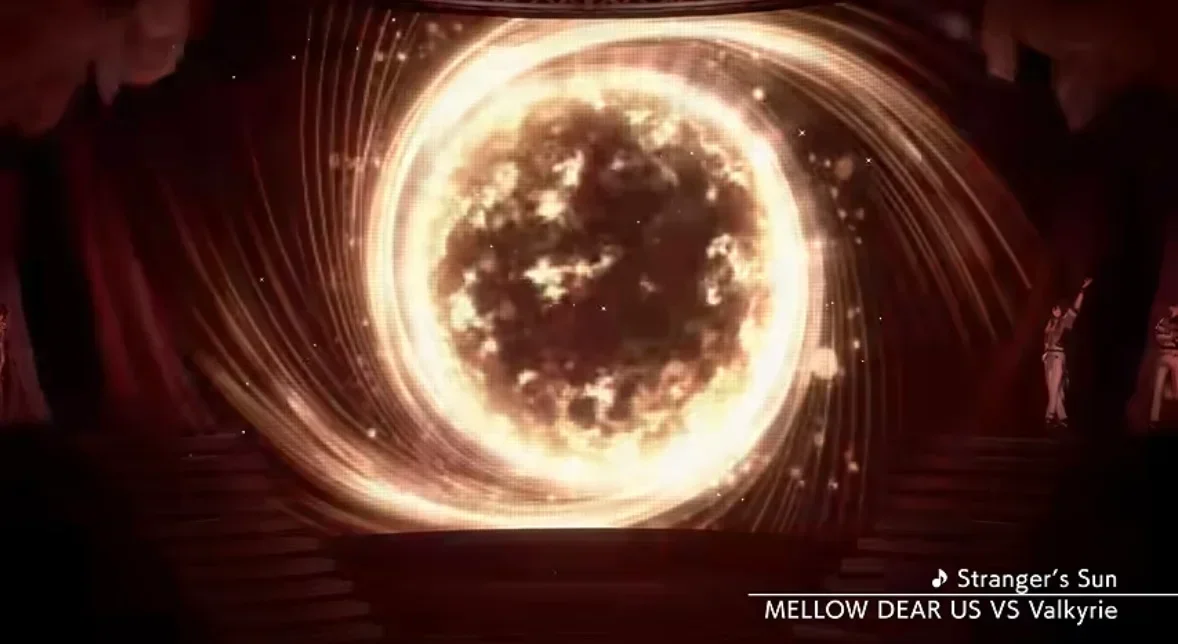
This is none other than "the masses (the system)" in this tournament.
The gaze of the masses, bundled together, becomes a mere "system," and it sides neither with Valkyrie, who raise the banner of eternity, nor with MDU, who live in the moment.
It takes no interest whatsoever in judging which philosophy is correct; through the output of a simple "Nice!," it merely showers them with irresponsible fervor (heat).
And yet, precisely because the sun (the system) is completely indifferent, two opposed souls can burn their lives against each other, on equal footing, beneath "the same one sun."
Precisely because this is a cruel world that treats no one as special, they can share this single stage, armed only with the purity of their own "Eternity" and "Moment" — is that not so?
Precisely because this is a cruel world that treats no one as special, they can share this single stage, armed only with the purity of their own "Eternity" and "Moment" — is that not so?
——Then, bathed over their whole bodies in this cruelly indifferent light, how do they seek to prove their own existence?
From here, I would like to consider MDU's "Moment" and Valkyrie's "Eternity" — the two entirely different modes of being that each presents.
MELLOW DEAR US — Those Who Show "Only" the Radiance
Let us sing the joy of living today
We should show them only the radianceEternity gives no value to the now
Burn the life that lasts but a single moment
In MDU's lyrics, only "light" and "now (the moment)" are drawn, thoroughly and completely.
"There is no regret here, no despair," Nozomi and Chitose laugh.
"There is no regret here, no despair," Nozomi and Chitose laugh.
But we know.
That each of them drags along, at their feet, pasts and traumas — and the still-unfolding shadow of ruin.
That each of them drags along, at their feet, pasts and traumas — and the still-unfolding shadow of ruin.
That shadow never once appears in the lyrics, and that limitation of a mere two characters — "only" the radiance. Paradoxically, this is exactly what proves the depth of their hidden darkness.
What was not written has not vanished; it has been hidden.
What was not written has not vanished; it has been hidden.
Here, I would like you to recall Meursault from earlier.
He was a man who could not perform.
He was a man who could not perform.
MDU, then, stand at the complete opposite pole.
They performed it to the very end.
Bringing no pain or suffering whatsoever onto the stage, they continue to offer the masses the brilliant dream they desire — perfect false images, bathed in scorching light.
They performed it to the very end.
Bringing no pain or suffering whatsoever onto the stage, they continue to offer the masses the brilliant dream they desire — perfect false images, bathed in scorching light.
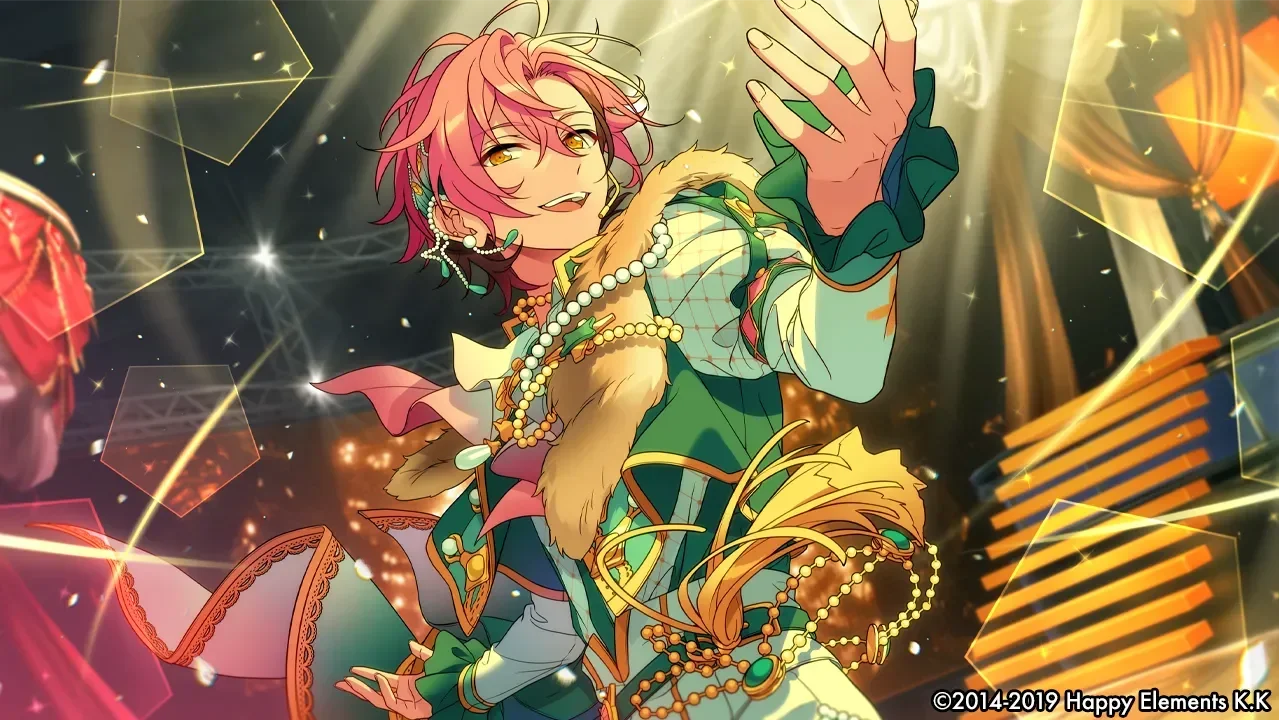
MDU, whipping the masses into a vortex of fervor. But Mika throws a certain question mark at them.
"Is what everyone desires the only ideal?"
"Is what everyone desires the only ideal?"
This is a question that drives a blade into the very root of MDU's philosophy of expression.
In answer, Mashu, Juis, Nozomi, and Chitose spin out one phrase each, responding to the question.
Nobody knows "the truth", so eyes show "the worth".
Everybody wants a dream, that's the meaning of "our prime".
Feel the stream in our music.
It is exactly like the thick, cold glass showcase MDU has built around themselves.
The questioning voice has unmistakably reached them. Their gazes meet through the glass, and they should understand the sharpness of that question almost painfully.
And yet, though it reaches them — it never, ever passes inside.
And yet, though it reaches them — it never, ever passes inside.
However earnest a question is thrown at them, they slip away with a beautiful smile — "Because 'everyone desires it,' don't they?" — and continue to place themselves within the perfect false image (dream) the masses demand.
It is not that they have given up on dialogue. I cannot help but feel an inescapable poignancy at the "resolve" of having chosen to exist inside that showcase of their own will — and, for that very reason, the cruelty of a severance that can never be crossed.
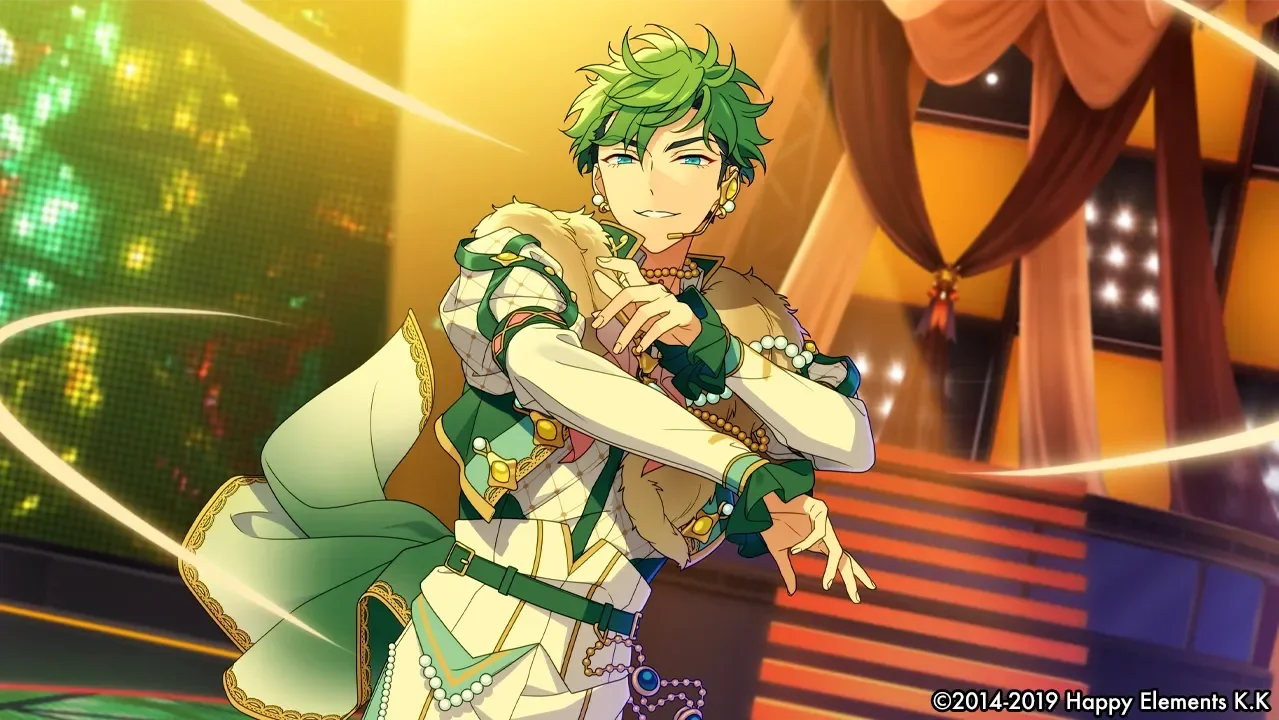
However, they are by no means sorrowful victims.
As if to brilliantly laugh off even the poignancy of that severance, Mashu sings it through:
As if to brilliantly laugh off even the poignancy of that severance, Mashu sings it through:
"I don't mind being a clown, either."
That they themselves are beings consumed by the masses (the system) — they understand this more coldly than anyone.
And on top of that, they deliberately bathe in the sun's heat with their whole bodies, burn up the life that lasts but a moment to its very limit, and create the fervor right before their eyes.
And on top of that, they deliberately bathe in the sun's heat with their whole bodies, burn up the life that lasts but a moment to its very limit, and create the fervor right before their eyes.
Playin' for grand show.
This is their own tremendous professionalism as they throw themselves into the moment — and the lofty pride they hold as idols.
Valkyrie — Those Who Leave Eternity Behind from Perishing Bodies
Though this body of mine will ere long rot and perish
I shall bequeath it to those who seek value
Valkyrie, on the other hand, do not fix their gaze upon "now."
Having once experienced "death" at the hands of the masses' irresponsible fervor — the thing they called a "revolution" — they transcended the limits of the flesh, and this very moment's system of consumption, long ago.
Death is not a terror to them.
It is merely a waypoint through which a work leaves its author's hands and becomes eternal.
That is precisely why Shu can declare: "Let us deliver a jewel a thousand years hence."
It is merely a waypoint through which a work leaves its author's hands and becomes eternal.
That is precisely why Shu can declare: "Let us deliver a jewel a thousand years hence."
(As an aside, this "jewel" had already been spoken of at the song's opening, in the exchange with Juis. There, Shu declares that, carving countless ages, he will polish a hope worthy of being a jewel. Even if, at this very moment, it is still a rough stone that cannot yet shine.)
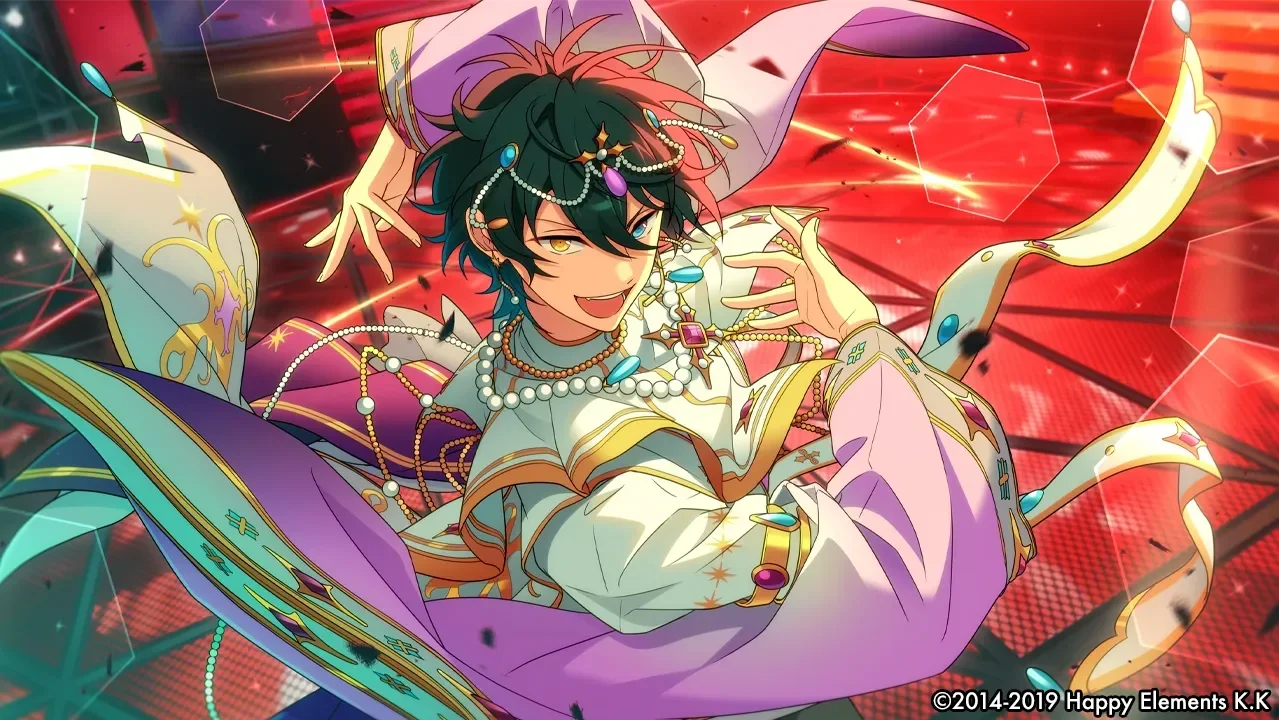
……And here lies the point that I completely misread in my previous analysis.
Open your eyes wide — the sun that burns unceasingly
Do you pity the flames upon the earth that fade away?
Yes — Valkyrie are not fighting the sun.
Shu sings: "Open your eyes wide — the sun that burns unceasingly."
Not "avert your eyes." Nor "strike it down."
Open your eyes, and gaze upon it, it says.
And Valkyrie continue — "the light, scattered in diffuse reflection, shone upon by the sun."
Not "avert your eyes." Nor "strike it down."
Open your eyes, and gaze upon it, it says.
And Valkyrie continue — "the light, scattered in diffuse reflection, shone upon by the sun."
Neither rejection nor submission. They catch the pouring light with their whole bodies, pass it through the crystal of themselves, and scatter its brilliance toward angles no one has ever seen.
In other words, rather than fighting it, they receive it, and transform it through themselves into radiance.
In other words, rather than fighting it, they receive it, and transform it through themselves into radiance.
Is this not the third relationship with the sun — the one reached by those who were once killed?
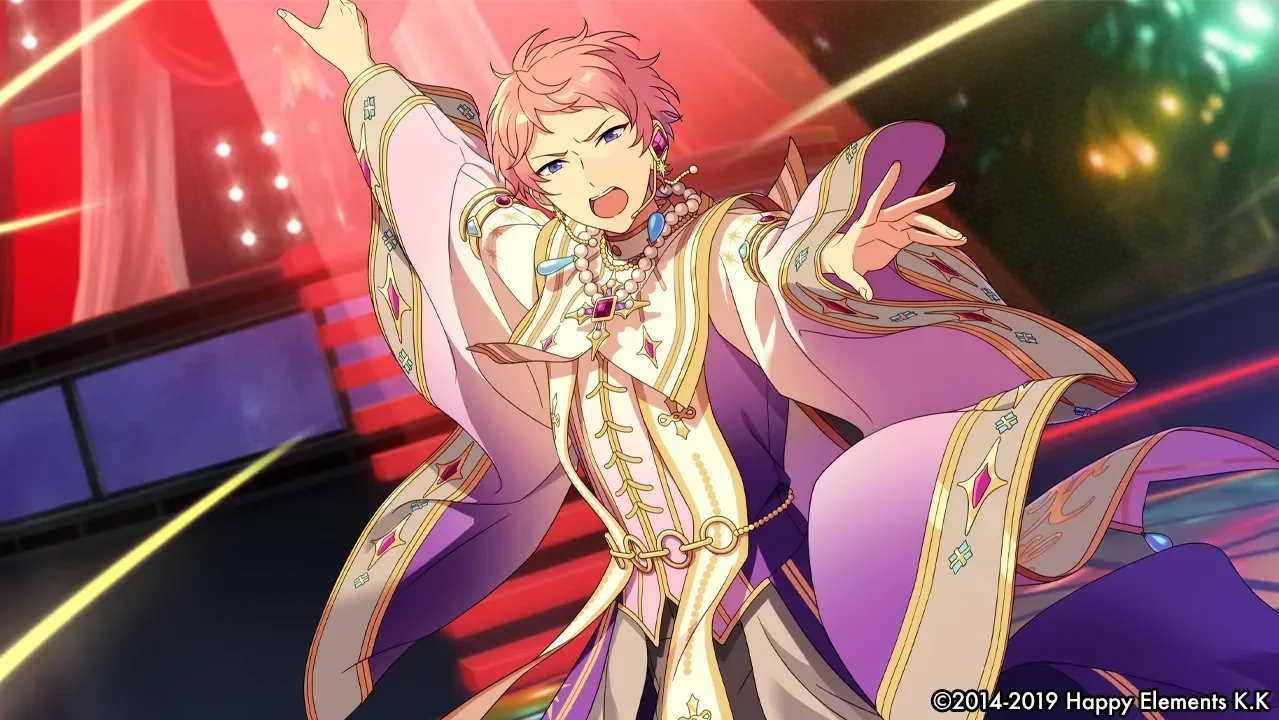
Now, do you remember the "Question and Answer" at the opening…?
That exchange in the first half, which sang of "the Moment and Eternity," is repeated once more, now in the form of the two units' leaders trading lines.
If the pleasure called empathy is happinessHear this: know that creation is enlightenment. The engraving resonance, across countless ages.
Let us polish a hope worthy of being a jewel.
What I want to draw attention to here is the "structure" of the phrases they sing.
First, Juis sings out: "If the pleasure called empathy is happiness."
First, Juis sings out: "If the pleasure called empathy is happiness."
The cheap empathy of "I get it!" that the masses demand of idols, and the momentary pleasure of consuming it for enjoyment.
If that, in this cruel world, is the masses' "happiness" — then——.
If that, in this cruel world, is the masses' "happiness" — then——.
At the very instant Juis throws out that conditional clause, what enters the position where the conclusion ("—then I shall…," "—then surely…") should have followed is not anyone from MDU. It is Shu's words.
"Hear this: know that creation is enlightenment. The engraving resonance, across countless ages. Let us polish a hope worthy of being a jewel."
True happiness, he says, is not to pander to the masses' desires, but to guide them with supreme art.
"Hear this: know that creation is enlightenment. The engraving resonance, across countless ages. Let us polish a hope worthy of being a jewel."
True happiness, he says, is not to pander to the masses' desires, but to guide them with supreme art.
It is a tremendous composition: the answer to the "if—" that MDU set up is seized from the side by Valkyrie and smashed apart.
Furthermore, the "countless ages (ikuseisō)" that follow mean an unfathomably long span of years.
Against MDU, who throw themselves into the radiance of this single moment, Valkyrie raise an eternal art that will be "engraved" into history across long ages — the contrast is structural.
Against MDU, who throw themselves into the radiance of this single moment, Valkyrie raise an eternal art that will be "engraved" into history across long ages — the contrast is structural.
They are by no means ignoring each other's claims as they sing their own songs.
Having clearly heard out the other's philosophy, they do not yield a single step.
Having clearly heard out the other's philosophy, they do not yield a single step.
Stealing words, clashing philosophies, scattering sparks that will never cross upon a single stage.
That, I believe, is the true nature of the stinging, tense beauty that flows through this entire song, "Stranger's Sun."
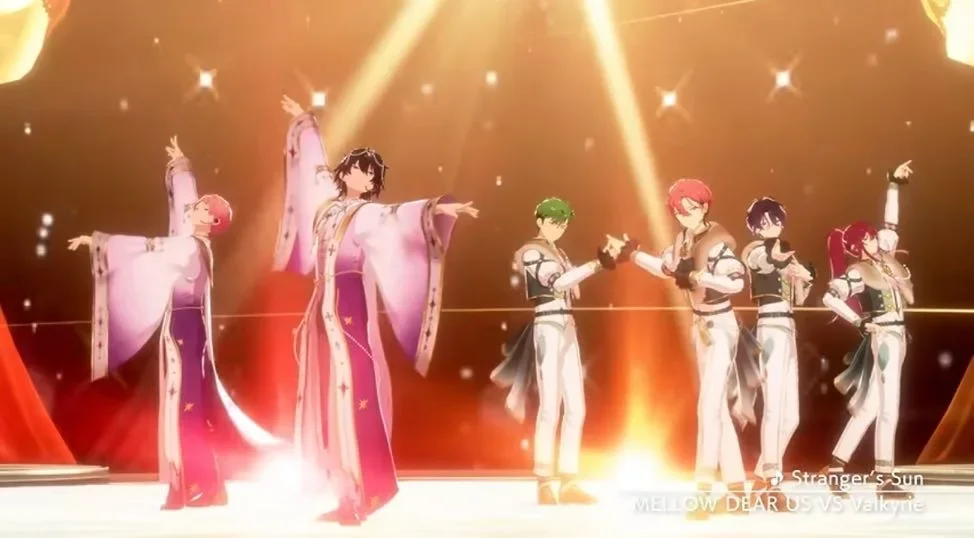
The Climax: Opposite Ideologies Poured into the Same Vessel
This is the light. This is the flame.
This is our pride. This is our beauty.This is the prism. This is the brightness.
This is the rhythm. This is the melody.Even if all are strangers, sun is one.
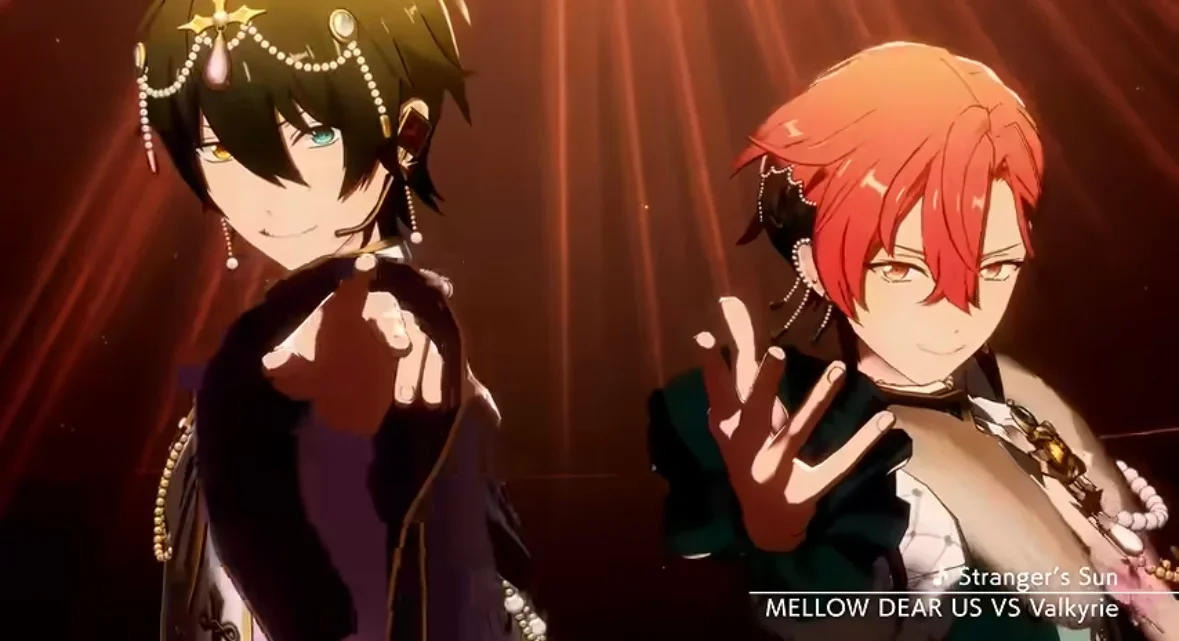
The most striking refrain in this song.
If we look carefully at the English words assigned to them here, a magnificent contrast rises into view.
If we look carefully at the English words assigned to them here, a magnificent contrast rises into view.
What MDU sing are "light," "flame," "rhythm," and "melody."
Words for the heat pouring down from outside, and for the art of "the moment," which has no form and vanishes on the spot.
Words for the heat pouring down from outside, and for the art of "the moment," which has no form and vanishes on the spot.
What Valkyrie sing, in contrast, are "pride," "beauty," "prism," and "brightness."
These are built from vocabulary expressing firm inner value, and a radiance of "eternity" that never crumbles.
These are built from vocabulary expressing firm inner value, and a radiance of "eternity" that never crumbles.
In particular, when we focus on the word "prism," with which Valkyrie likened themselves, a cruel and beautiful fact surfaces.
A prism, that body of glass, does not emit light of itself.
It is a device for catching the light that enters from outside, refracting it within itself, and returning it beautifully dispersed.
A prism, that body of glass, does not emit light of itself.
It is a device for catching the light that enters from outside, refracting it within itself, and returning it beautifully dispersed.
This matches, without the slightest deviation, their stance of "being exposed to the sun (the masses' fervor), yet scattering it in diffuse reflection to create eternal art."
Valkyrie transform the masses' indifferent heat into supreme beauty.
Valkyrie transform the masses' indifferent heat into supreme beauty.
And the song comes crashing into that passage, where the two diametrically opposed units layer their voices at the same time.
Eternal afterglow (Valkyrie) × Playin' for grand show. (MDU)
An "afterglow" is the light that lingers in the sky even after the sun has set and its source has been lost.
In a world where an end will surely come someday, Valkyrie sing of an "eternity" that continues to remain even after the source of light (the masses, the era) is lost.
Layered over it is MDU, singing of "the moment" — staking everything on the supreme show of this very instant, and burning out.
In a world where an end will surely come someday, Valkyrie sing of an "eternity" that continues to remain even after the source of light (the masses, the era) is lost.
Layered over it is MDU, singing of "the moment" — staking everything on the supreme show of this very instant, and burning out.
The time after the source of light has vanished (eternity), and the fervor that exists here and now (the instant).
Two times that can never cross overlap as a single chord, beneath the same "indifferent sun."
Two times that can never cross overlap as a single chord, beneath the same "indifferent sun."
In this moment, our hearts are wrapped in an emotion that shakes them beyond our control.
The "One Sun" Made Visible in the MV
This polar opposition drawn by the lyrics was further emphasized, and made visible, by the staging of "light and shadow" in the video.
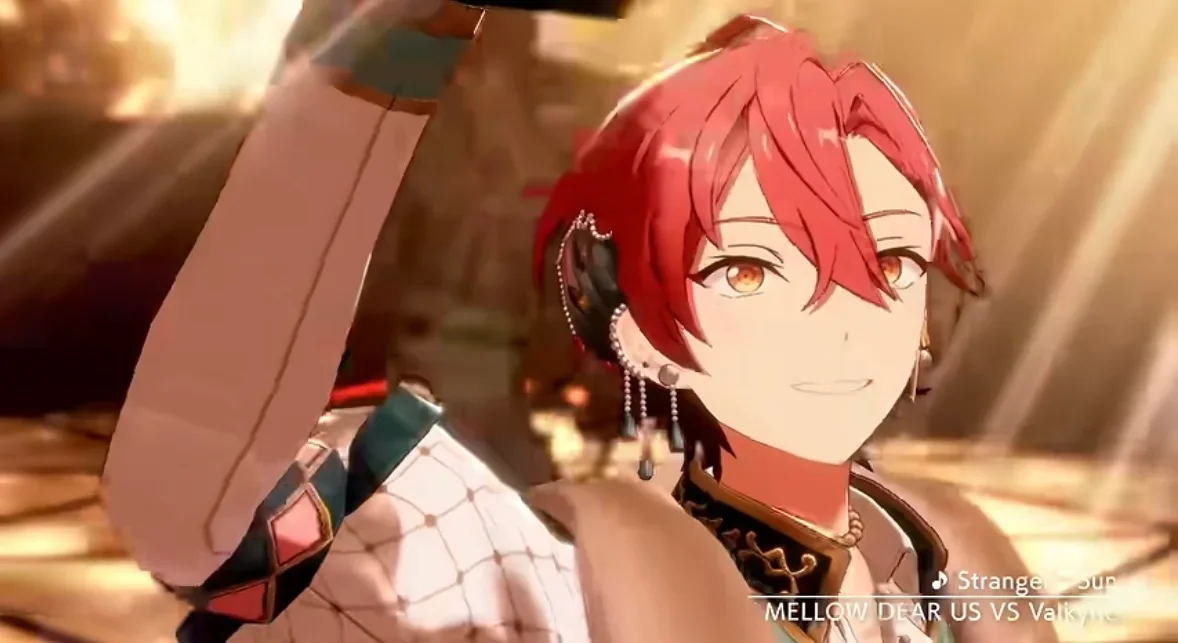
In the video, MDU's Mashu places himself within whitish, dazzling light and, narrowing his eyes against the glare, gazes straight up at the heavens with shining eyes.
It is the very figure of one who never flees the intense light from outside that is the masses' acclaim, but bathes in it head-on with his whole body and shines.
It is the very figure of one who never flees the intense light from outside that is the masses' acclaim, but bathes in it head-on with his whole body and shines.
In contrast, Valkyrie's Mika, in red-black darkness where no light falls, makes only his two eyes glint bewitchingly, like a cat's.
Here, there is one thing I want to confirm. For eyes to shine in the darkness means that light is reaching them.
Mika's eyes are not shining of themselves.
He does not pander to the midday light, yet he surely catches the light that reaches him, and returns it.
He is a prism — light shone upon by the sun and scattered in diffuse reflection. Eyes that receive light even within the darkness — thinking of it that way, that moment's glimmer holds an even quieter beauty.
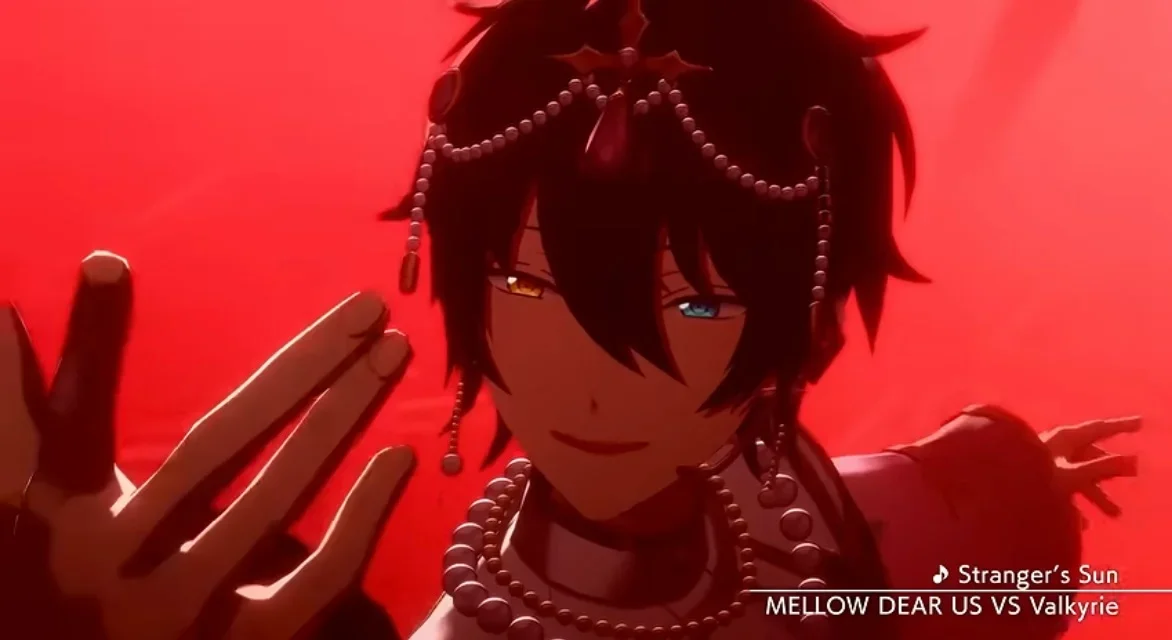
One who is scorched by the outside light and shines (MDU, Mashu), and one who returns light even in the darkness (Valkyrie, Mika).
This visual contrast, together with the polarity of the lyrics, perfectly expresses the difference in their modes of being.
This visual contrast, together with the polarity of the lyrics, perfectly expresses the difference in their modes of being.
——And then, the most decisive element of this video's staging.
The mirage that sways gently across the screen in the final cut.
A mirage is a phenomenon in which, when the air at the ground's surface warps, unable to bear the heat, it shows us things that should not be there.
Mashu in the light. Mika in the darkness.
Two people whose standing places, whose ways of living, whose very times they gaze upon are all different.
Before both of them, the same wavering passes across.
Which is to say: they are within the same heat. Within a heat so abnormal it warps the air itself.
Even if all are strangers, sun is one.
Even divided into light and shadow, the thing scorching them is one — there could be no greater proof.
[Afterword] The Clash of Perfected Philosophies — A Collision over the "Vessel" Called Idol
Finally, please allow me just one addition, from a personal perspective.
In this "Stranger's Sun," the secrets and depths of the characters — centered mainly on Mashu and Mika — are about to be revealed upon this very stage, right now.
Precisely because their stories are being told in the present progressive, what drives the deepest layer of the "eternity and moment" flowing at this song's root is the presence of the two units' leaders, Shu and Juis, who have already established their own philosophies.
Precisely because their stories are being told in the present progressive, what drives the deepest layer of the "eternity and moment" flowing at this song's root is the presence of the two units' leaders, Shu and Juis, who have already established their own philosophies.
Juis, in particular, has already had his past depicted in meticulous detail in an earlier story: his past with his producer — and cousin — "NiceP."
The irreparable guilt of having had to, by the designs of his family, steal away and erase with his own hands the seat of the "idol (NiceP)" he had loved from his heart.
That is precisely why Juis fiercely hates and despises his own self, who sits in that stolen seat, and the very existence of "idols."
That is precisely why Juis fiercely hates and despises his own self, who sits in that stolen seat, and the very existence of "idols."
For him, an idol must be "something empty and worthless, toward which the irresponsible fervor of the rabble masses is directed, consumed without anyone ever looking at what is inside."
It is as though he looks down upon and mocks the entire idol system that celebrates him — he who stole true radiance — and, at the same time, continues to punish his own consumed self.
That is precisely why he can throw himself, ruinously, into the "storm of the moment" that is cheers and fervor (mania).
Shu, on the other hand — who once saw hell at the hands of that same irresponsible fervor of the masses — has arrived at the state of mind that "even the framework of the idol is nothing more than a medium (a canvas) for outputting supreme art."
For him, an idol is a "proud vessel" for leaving eternal beauty, which shines on even after death, to posterity.
For him, an idol is a "proud vessel" for leaving eternal beauty, which shines on even after death, to posterity.
Something worthless, existing to be consumed by the masses — or something capable of harboring eternal art.
When these two, whose philosophies are already complete, clash head-on, what is born there is not mere victory or defeat.
Before Juis — who has punished himself by despising idols as "things merely to be consumed" — there appears Shu, there appears Valkyrie, embodying in the vessel called idol an "eternal art that can never be burned away, no matter how much the masses consume it (no matter how harsh a sun scorches it)."
Of course, the deep curse he carries will not be undone by this single battle.
But when two souls that should never have crossed clash within the same heat, how will the "eternity" that Valkyrie depicts appear in Juis's eyes?
Perhaps it may bring a quiet wavering to the root of the "worthless system" he so firmly believed in, and become a faint "presentiment of light."
But when two souls that should never have crossed clash within the same heat, how will the "eternity" that Valkyrie depicts appear in Juis's eyes?
Perhaps it may bring a quiet wavering to the root of the "worthless system" he so firmly believed in, and become a faint "presentiment of light."
For now, I simply want to pray, quietly, that at the end of this harsh, mud-drenched battle, such a small sign of change may visit their souls.