
Introduction — Two Phrases I Kept Seeing on X
Thank you, as always, for reading this blog.
Ever since the MV for "Stranger's Sun" unveiled costumes that completely ignored every pattern that had come before, I've been looking through social media such as X (formerly Twitter) and repeatedly coming across two expressions.
"Valkyrie looks like priests" "MELLOW DEAR US (MDU) looks like medieval European nobles"

It wasn't just one or two people. A great many people had the same intuition.
On first viewing, I completely agreed myself.
On first viewing, I completely agreed myself.
But what I couldn't let go of was the fact that those two phrases stood side by side.
Priests, and nobles. Those who serve God, and those who stand at the pinnacle of the secular world.
On the left and right of the same stage, two such polar opposites were standing.
Priests, and nobles. Those who serve God, and those who stand at the pinnacle of the secular world.
On the left and right of the same stage, two such polar opposites were standing.
To give the conclusion first: Valkyrie is unmistakably wearing the clothes of priests.
Unravel their detailed features, and they overlap in many places with medieval liturgical vestments.
Unravel their detailed features, and they overlap in many places with medieval liturgical vestments.
However, MDU had features different from "medieval nobles." What they are wearing is "16th-century, Renaissance court dress." It is a style from roughly three hundred years after the Middle Ages.

"…But aren't they both just old European noble clothes?" I can almost hear the objection — but this time, this "three-hundred-year gap in time" is precisely the greatest theme I want to unravel in this article.
Why is there a three-hundred-year divide upon the same stage?
Following that meaning led me, eventually, to a drama of history spanning several centuries that even seems to hint at the "conclusion" of their conflict.
Following that meaning led me, eventually, to a drama of history spanning several centuries that even seems to hint at the "conclusion" of their conflict.
ATTENTION
I have written the descriptions of costume history and art history after researching them, but the mapping onto the characters and the reading of meanings are entirely this blog's hallucinations.
Whether they were officially designed that way is completely unknown.
I hope you'll indulge me on that understanding.
Well then, let us organize the features of each costume.
What Valkyrie Wears — Medieval Liturgical Vestments
First, let us look closely at the costumes on the Valkyrie side, and their features.
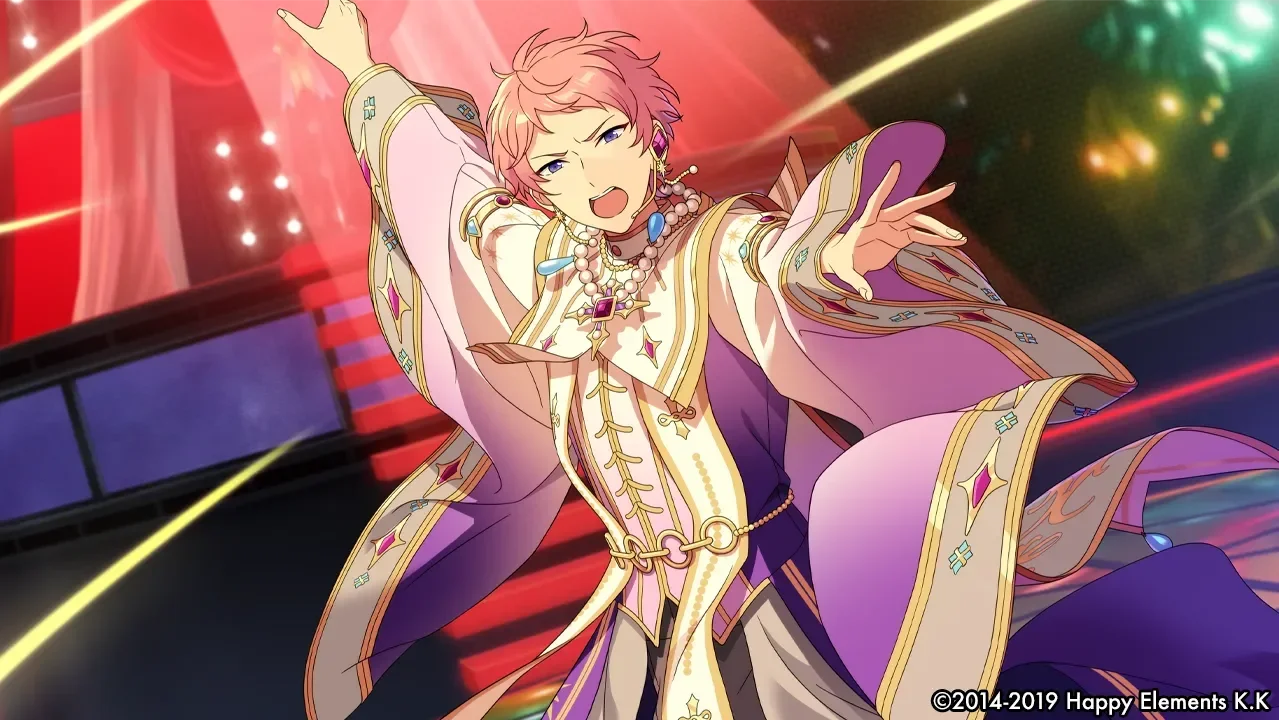
The Wide Sleeves and the Two Vertical Bands
The first things that catch the eye in those costumes are the large sleeves that spread horizontally from the shoulders and the decorative bands running vertically down the center of the body. These two features can be completely explained by a single garment. The "dalmatic."
The dalmatic is a T-shaped garment with wide sleeves and a loose body. Established in the 4th century as the uniform of deacons, it is still used today as a Christian liturgical vestment. Its body is characterized by two vertical lines called clavi.
[Correction and Update] In the Japanese Mythology article and the "Hagoromo and the Woodcutter" article, I twice read those sleeves as "something from Japanese dress." Both readings were wrong. The dalmatic is a Western liturgical vestment with precisely such horizontally spreading sleeves. My own vocabulary of Western costume was lacking…
White, Purple, and Gold — What Each Color Means
Next, let us look at the use of color. Catholic liturgical colors each have a fixed meaning.
-
White — sacredness and joy.
-
Purple — penance and preparation.
-
Gold — a special color that may be used in place of the liturgical color on feast days. It symbolizes the glory of heaven, the power of God.
Let us look at Valkyrie's costumes. On a ground of white, purple enters as a gradient accent color, and they are trimmed with gold. Sacredness, penance, and the glory of heaven.
It may be a coincidence. But all three are colors that carry meaning in the liturgy, and all three are present together. It matches beautifully the interpretation that what they are wearing is "the clothing of those who serve God."

The Vertical "Gothic Style"
And one more thing. The silhouette of those costumes is a "vertical line" that reaches the floor. This vertically extending silhouette is the formative language of "Gothic."
Gothic architecture was born in 12th-century France. To give form to the prayer "more light, higher toward heaven," it abandoned heavy stone walls and created overwhelmingly tall spaces that make you look up — that was its beginning.
That verticality is not mere decoration. It is a symbol of faith toward heaven. The height of the buildings, the light pouring in through stained glass — all of it was the religious orientation itself: "to draw even a little closer to heaven (God)."
What MDU Wears — 16th-Century Court Dress
Now, what of MELLOW DEAR US, standing on the opposite side?
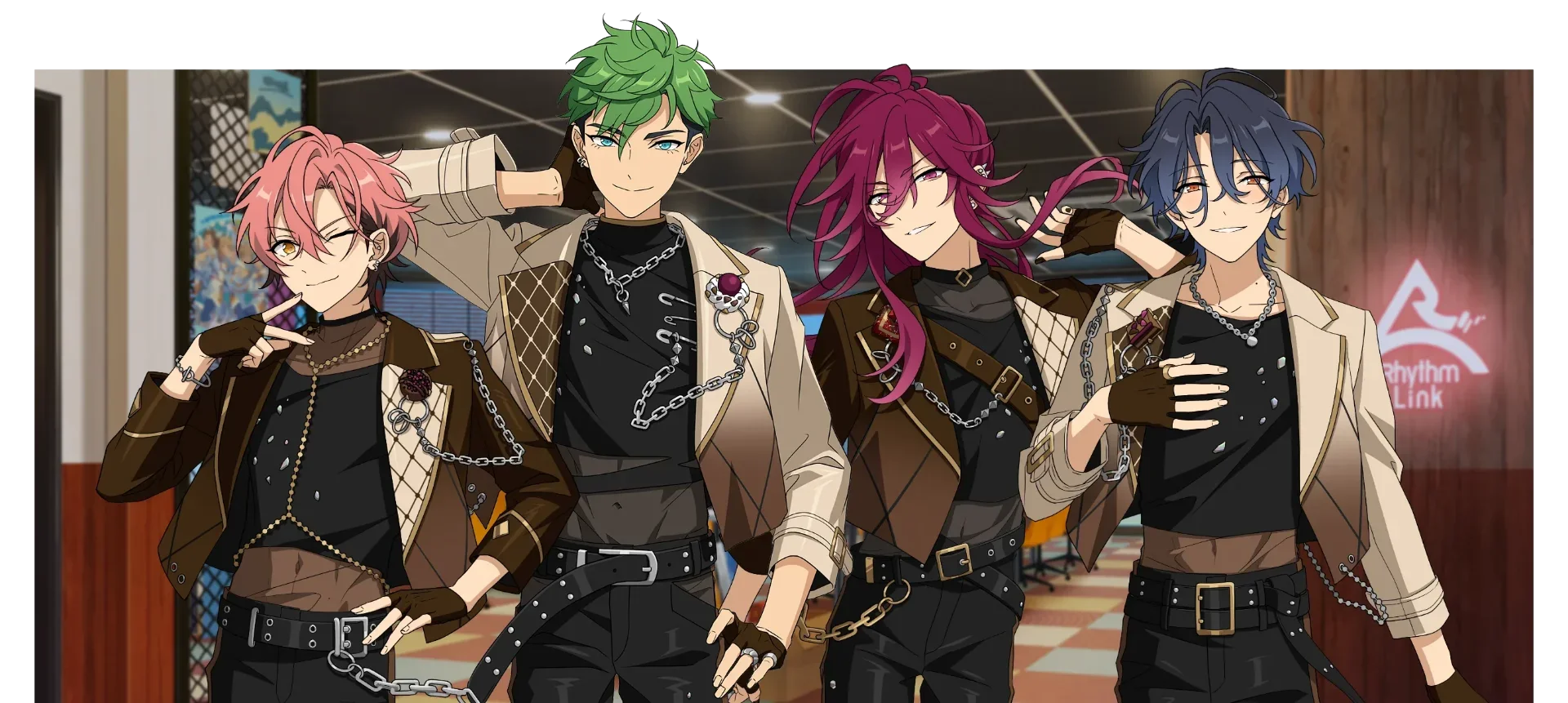
Juis, Nozomi, Mashu, Chitose. At first glance, the impression is of costumes with a noble taste overall, while also incorporating the motifs of the circus — which is also Mashu's roots.

But look at the fine details, and a shared vocabulary clearly emerges.
-
Fur shoulder pieces — all four wear a large expanse of fur wrapped from around the neck to the shoulders.
-
Puffed shoulders and tiered sleeves — a form of lattice quilting fastened with jewels. Softly billowing puff sleeves.
-
A torso cinched with a belt — body-conscious tailoring, with a slim belt tightened along the lines of the body.
-
Frills at the collar and sleeves
-
Pearls and gold chains draped diagonally across the chest — like the frills at the collar and sleeves, adding gorgeousness.
-
Cabochons of colored stones in gold settings (a cutting that rounds the stone and polishes it to a shine) placed all over the body.
Let us match these against descriptions of 16th-century dress.
Before long, padding came to deliberately create an imposing figure of broad shoulders and a thick chest, and to emphasize it further, the torso was made slimmer (in some cases even using corsets to do so).—Wikipedia, "Pourpoint"
Sleeves were greatly puffed at the shoulder, or given tiers. At the neck, the collar of the chemise became an independent cuff, and a decorative collar called the fraise (ruff) came to be worn. The upper classes adorned their clothes with jeweled buttons and fine gold-thread embroidery. (Wikipedia, "Western Dress (16th Century)")

Not a mere match — an almost complete correspondence.
And the finishing touch is the "fur" gorgeously adorning the neck.
Since the Gothic period, fur lining and trimming, such as sable, has been a symbol indicating aristocratic rank and status.
Precisely because it is rare and expensive, wearing it itself becomes proof of wealth and power.
And the finishing touch is the "fur" gorgeously adorning the neck.
Since the Gothic period, fur lining and trimming, such as sable, has been a symbol indicating aristocratic rank and status.
Precisely because it is rare and expensive, wearing it itself becomes proof of wealth and power.
[Correction and Update] In the "Hagoromo and the Woodcutter" article, I read this fur as "a woodcutter's equipment for surviving in the forest." But from the perspective of costume history, fur is not a tool of the forest, but a sign of the court.
This time, I adopt the latter interpretation.
Furthermore, in this era, "sumptuary laws" were imposed in each country. The materials, colors, and decorations one was permitted to wear according to rank were strictly determined by law.
In other words, their attire is not merely gorgeous; it also carries the meaning "we are of a rank permitted to wear this."
In other words, their attire is not merely gorgeous; it also carries the meaning "we are of a rank permitted to wear this."
What MDU wears is not the sacred Middle Ages, but the "secular power" brought by the Renaissance.
And the fact that they are wearing these clothes is itself deeply suggestive.
Juis — who views idols as a consumption system and cannot love — ironically wears clothes that proclaim "I am of a rank permitted to wear this," and perfectly carries off the most luxurious uniform of power.
And Mashu — who has roots in the circus and sings that he does not mind letting himself be consumed as a clown — wears the pourpoint, which by padding "artificially creates the ideal body (= wears a false image)."
And Mashu — who has roots in the circus and sings that he does not mind letting himself be consumed as a clown — wears the pourpoint, which by padding "artificially creates the ideal body (= wears a false image)."
Their very ways of being match beautifully the themes of "the secular and the false image" held by 16th-century dress.
What Separates the Two Costumes — How They Treat the Body
Now to the main subject. The greatest difference between the two costumes is neither color nor decoration. It is "how they treat the body."

The dalmatic (Valkyrie) is T-shaped. The cloth is cut in the shape of arms spread wide to the sides; it picks up neither the waist, nor the shoulders, nor the line of the chest at all. Whatever shape the body may have, the appearance after wearing becomes the same garment. In other words, it is clothing that completely ignores the lines of the body.
The pourpoint (MDU) is the opposite. It inserts padding to look imposing, puffs the shoulders, cinches the waist tight. This is not even clothing that "shows" the body. It is clothing for "displaying" — artificially creating the ideal flesh.
Why did such a change occur as the ages passed?
The answer lies in art history, continuous with costume history.
The answer lies in art history, continuous with costume history.
In medieval Europe, Christianity viewed bodily desire negatively, and God and the Church held absolute authority. In both the Romanesque period and the Gothic period, works depicting the nude bodies of men and women almost do not exist. Human beings were not, in the first place, subjects of creation.
What overturned that was the Renaissance's humanism. Against the God-centered worldview, finding beauty and value in humanity itself — the human body changed from something to be hidden into something to be beautifully praised.

To wear God, or to wear humanity.
The unbridgeable distance between the two costumes, the two units, lies exactly there.
The unbridgeable distance between the two costumes, the two units, lies exactly there.
The Hidden Side of the Word "Gothic"
And there is one more fact that made my hand stop while I was researching.
—The word "Gothic" was originally a "term of contempt."
—The word "Gothic" was originally a "term of contempt."
From the 15th century into the 16th, the people of the Renaissance, regarding the art of the earlier Middle Ages as crude and barbaric, called it "Gothic (= in the manner of the Goths)."
That name then became fixed, just as it was, as the name of the style.
That name then became fixed, just as it was, as the name of the style.
Why did they detest the medieval style as "barbaric"?
The absolute standards of beauty the Renaissance loved dearly were "calculated mathematical harmony," "the perfection of symmetry (balance)," and "beauty well-proportioned as seen by humans."
In their eyes, Gothic verticality — ignoring the human scale and stretching endlessly toward heaven — and its excessive decoration, filling every blank space, appeared like irrational, deformed monsters.
…Here, let us look back at how the unit MDU came to be.
MELLOW DEAR US's philosophy, and the group's very way of being, match this "Renaissance aesthetic" completely.
-
**
MDU is a group that their producer, Nice, read the currents of the era perfectly and assembled at the end of meticulous calculation.
Despite the fact that Nice's own true tastes are for cute things like Ra*bits, what he created was an existence at the very opposite pole. -
**
MDU is a high-performance collective in which every member holds ace-class potential.
And Chitose, in particular, has an abnormal perfectionist temperament — driving himself so far as to contemplate suicide over his singing entrance or choreography being off by a fraction of a second.
Their stages are always required to have a balanced beauty without a hair's breadth of deviation, and their degree of completion is so high that the idols of ES lose their confidence across the board. -
**
Their absolute standard of value is "how the audience (humans) feel when they see it" and "how much they can make them cheer and drive them into a frenzy."
Not the viewpoint of God, nor their own sensibilities — whether it is beautiful as seen by humans on the ground is everything.
Calculated harmony, perfect performances without a hair's breadth of deviation, and a standard of value centered on "humans," the audience.
MDU's philosophy itself is the spirit of the Renaissance.
That is precisely why Valkyrie's way of being — ignoring the human scale and seeking to serve "art born of the impulses of the inner soul" — must appear to them as "something barbaric and hard to understand."

"Stranger's Sun," the deciding task song of "MELLOW DEAR US VS Valkyrie."
Upon a stage prepared as a "showdown" between idols, that "VS" structure had, in fact, already begun several hundred years ago in history.
—The Renaissance that MDU wears looked down on the Middle Ages that Valkyrie wears, called it "barbaric," and named it so. In other words, the very name of the style "Gothic" had this opposition (VS) of two aesthetics engraved into it from the beginning.
You could call it a coincidence, and that would be the end of it.
But without any forcing on my part, merely lining up the facts of art history beside their philosophies makes them overlap to a frightening, beautiful degree.
But without any forcing on my part, merely lining up the facts of art history beside their philosophies makes them overlap to a frightening, beautiful degree.
The Same Stage, Different Centuries — The Opposition Shown by Two Frameworks
Let us organize the information so far.
| Element | Valkyrie | MDU |
|---|---|---|
| Era | Middle Ages (Gothic) | 16th century (Renaissance) |
| Costume | Liturgical vestment · dalmatic | Court dress · pourpoint |
| Form | Ignores the body | Creates the ideal body |
| Orientation | Vertically, toward heaven | Horizontally, toward the earth |
| Center | God | Humanity |
The first impression of "priests and nobles" was half right.
But the two units' true distance is not a difference of occupation. It is a three-hundred-year difference of era.
But the two units' true distance is not a difference of occupation. It is a three-hundred-year difference of era.
And the stage, like the game's stage, was France. The country where Gothic was born, and also the country that imported the Renaissance from Italy. On the land where the two styles actually stood side by side, these two units now stand.
In the main analysis, I read this song "Stranger's Sun" as a clash of "eternity and the moment."
Valkyrie sings of leaving things behind for those who seek value even as they decay and perish. Art that remains even after death. The eternity the age of God believed in.
MDU sings of burning a life that lasts only an instant. The joy of living today. The moment the age of humanity celebrates.
MDU sings of burning a life that lasts only an instant. The joy of living today. The moment the age of humanity celebrates.

That was a difference of thought, and at the same time a difference between the age of God and the age of humanity. The costumes, I think, were saying so from the very start. The two stand in medieval liturgical vestments, and the four stand in Renaissance court dress.
Upon the same stage, they face each other across three hundred years of time.
Upon the same stage, they face each other across three hundred years of time.
In Place of a Conclusion — History Has a Sequel
At the beginning, I wrote that this three-hundred-year divide hints even at the "conclusion" of their conflict.
Finally, let me check that answer, and close this article.

In history, the Renaissance won.
The Middle Ages ended, Gothic was called "barbaric," and the age of humanity came. Looking only at the order, MDU stands on the side of the next era.
But history did not end there.
From the late 18th century into the 19th, the Gothic Revival occurred in England. From criticism of classicism, medieval architecture was reevaluated, and the movement spread to France and Germany. And at this time —
Gothic, "without being dismissed as coarse or barbaric, was reborn as a patriotic style representing the nation."
Killed once, despised for hundreds of years, and still it returned.
That is the subsequent history of the style Valkyrie wears. And they themselves have walked the same path. Killed once, shut away underground, keeping the light at a distance, dragged out by force, and now standing upon the stage.
—Let us send these jewels a thousand years into the future
Eternity may not mean never being forgotten. Even if forgotten once, to return without fail.
As the Gothic style did.
As the Gothic style did.

I do not know how the victory or defeat of this tournament will turn out.
But the time that what they wear points to is, I think, far longer and deeper than a single win or loss.
But the time that what they wear points to is, I think, far longer and deeper than a single win or loss.
[Teaser] By the Way, There Is One Man Whose Movement Is Different
Just one last thing.
In this article, I have organized the two costumes as "vertical and horizontal," "God and humanity."
However, in the MV's final cut, there is one person clearly straying from that law.

Three of MDU — Juis, Mashu, Chitose — hold their hands together before their chests and extend them toward the audience seats in front. A horizontal gesture. A motion directed toward humans, toward the earth.
But the one person at the right edge alone stretches his arm straight up.
Nozomi Madoka.
While wearing Renaissance court dress, only the direction his body indicates faces the vertical of the Valkyrie side.
Why does he alone point at the heavens? When I reread his monologue in the booklet Chocolat Assort, a chilling answer came into view.
But if I start on that, it becomes another whole article's length all by itself. I will write it carefully, in a separate article…!